
Problem:
Create a competitive swerve drivetrain suitable for robotics competitions and general robotic assistance tasks that maintains low power draw, is simple to maintain, and uses cheaper, widely available parts than traditional swerve systems. Most conventional swerve systems rely on expensive components, complex mechanics, and high current demands.
Method:
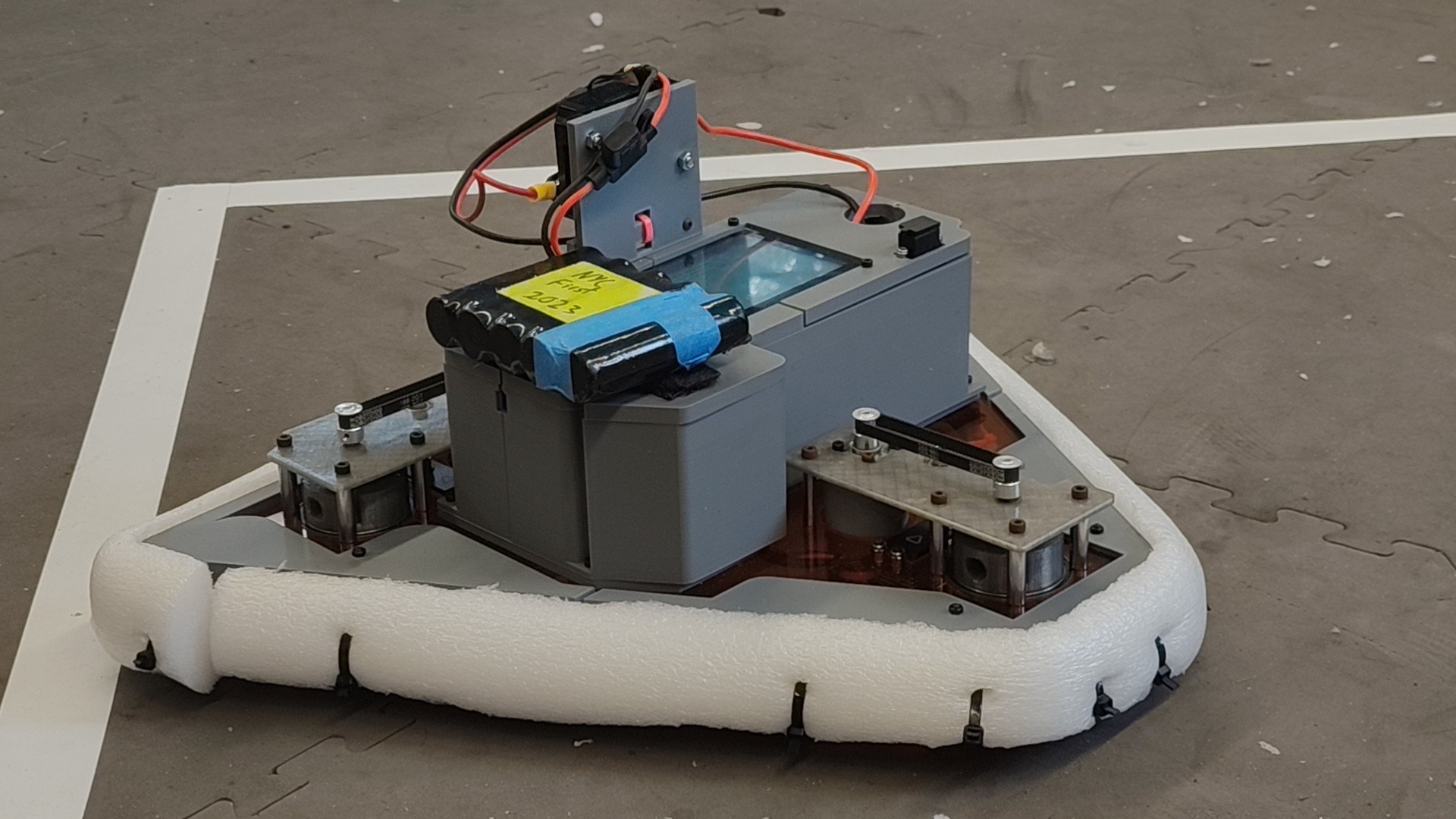
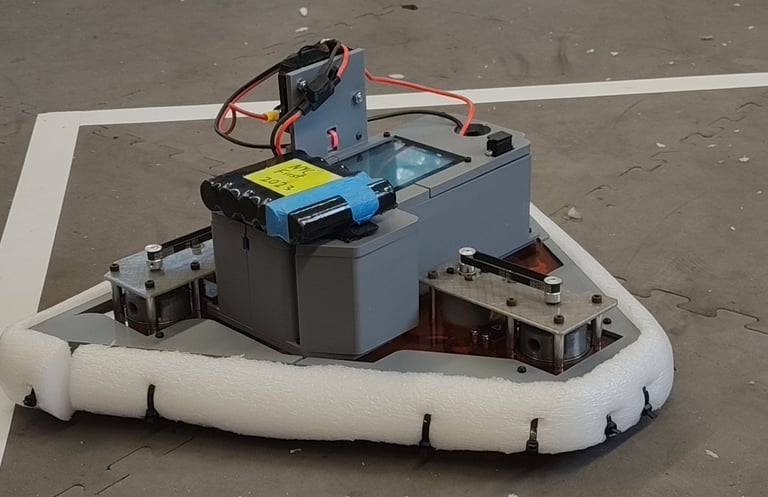
Designed a custom Kiwi swerve drivetrain using three modules instead of four, reducing system complexity, cost, and power consumption.
Eliminated one drive motor and one steering actuator compared to traditional four module swerves.
Implemented continuous rotation (CR) servos for steering paired with external encoders instead of positional servos.
Used encoder based absolute angle feedback to allow CR servos to function as precision steering motors through software control.
Maintained perfect chassis symmetry, critical for stable motion and accurate kinematics in a three module swerve system.
Built a custom electronics stack, including:
Raspberry Pi running Python.
10-amp motor drivers for drive motors.
12-bit encoder board for high resolution steering feedback.
Servo HAT for CR servo control.
Developed custom control software entirely in Python handling:
Kiwi swerve kinematics.
Closed loop steering control using encoder feedback
Power efficient motor output scaling.
Real time synchronization between steering and drive systems.
Result:
Significantly reduced cost by replacing traditional steering motors with CR servos and encoders.
Lower overall power draw due to fewer motors and optimized power distribution.
Achieved full omnidirectional movement with fewer mechanical components.
Simplified maintenance through use of generic, widely available parts.
Increased reliance on software precision and encoder calibration, enabling flexibility and rapid iteration.
Demonstrated a practical, efficient, and accessible swerve drivetrain suitable for both competitive robotics and assistive robotic applications.
Click the photo to find out more!
Dorito Custom Swerve Drive

Problem:
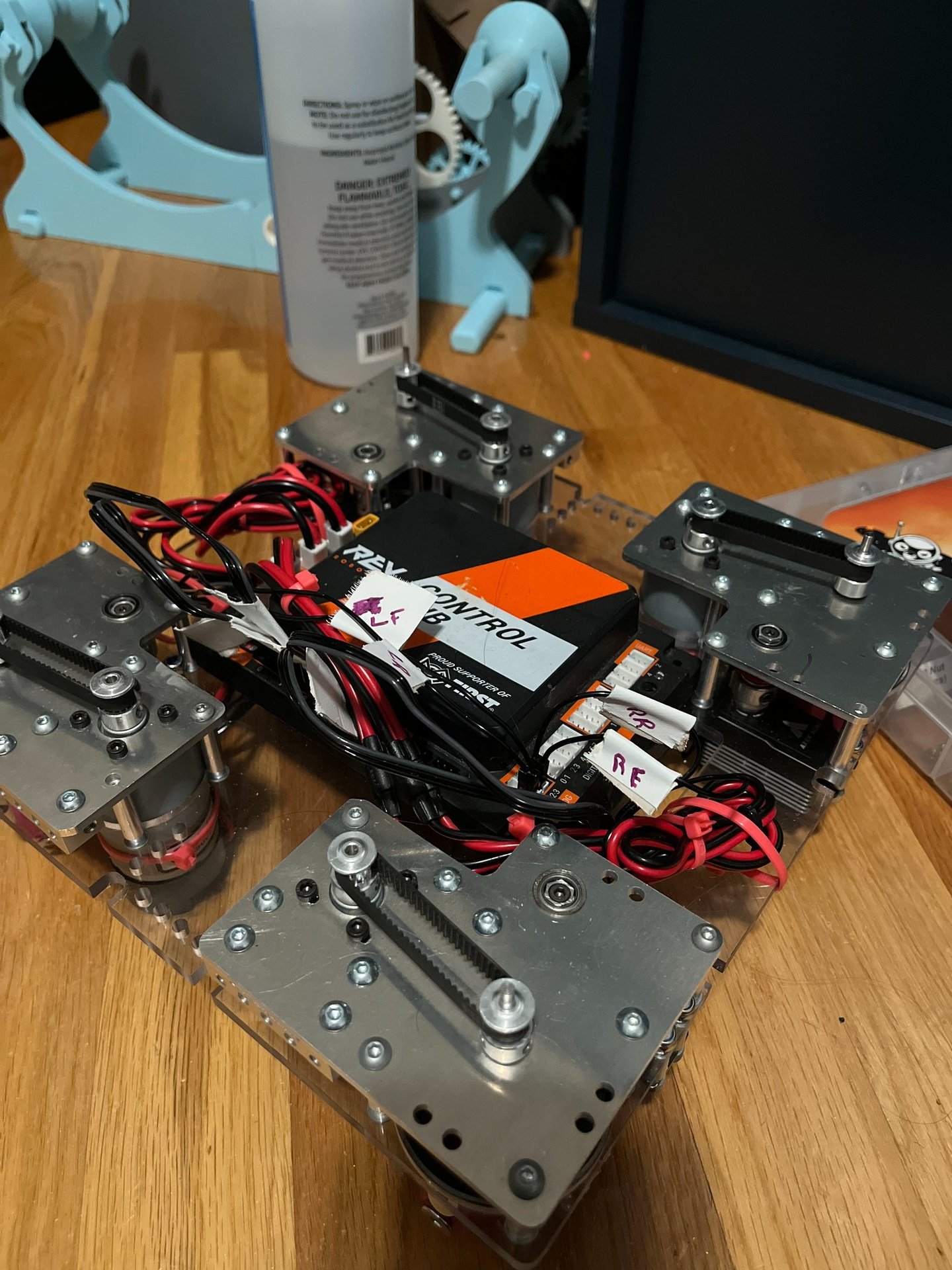
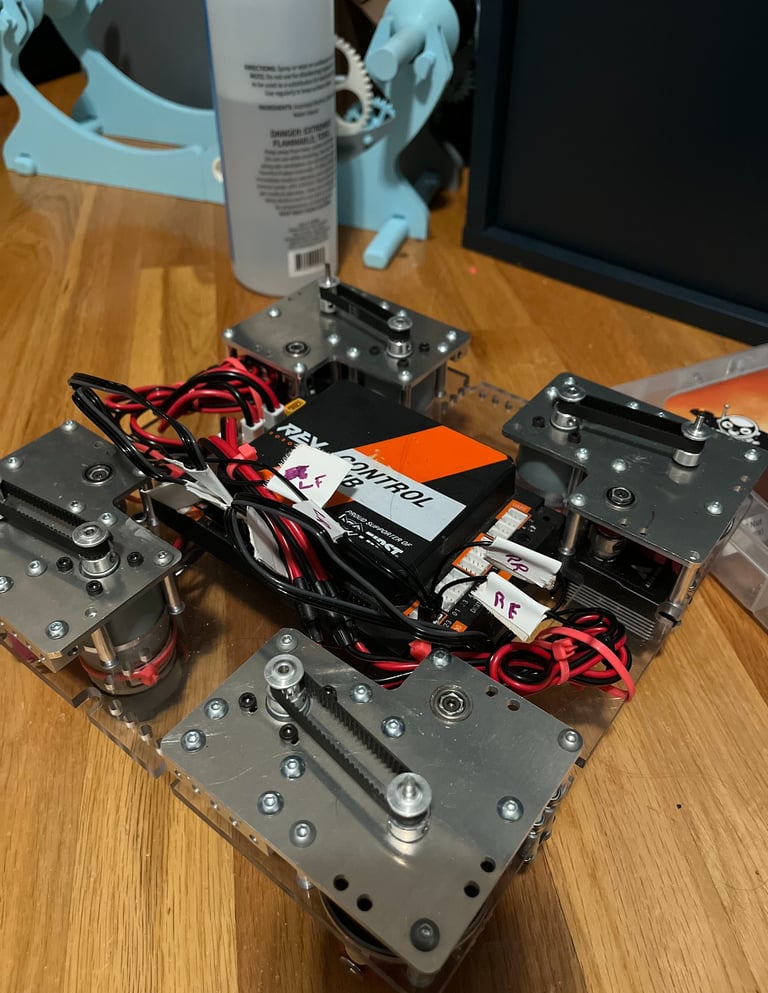
Make compact and affordable swerve drivetrain modules for FTC robots, since traditional pods are too big and too expensive for most teams.
Method:
Designed first prototype under 4in × 4in × 4in using 3D printed structural parts to hold shafts, gears, and bearings.
Manufactured and assembled a full drivetrain using four pods (1 motor + 1 servo per pod).
Evaluated costs and mechanical performance.
Created a second prototype with changes:
Switched to generic parts from Amazon/AliExpress to reduce cost.
Increased module height by < ¼ inch.
Changed module shape from L shaped to rectangle.
Updated hole pattern to fit Gobilda, REV, and Andymark build systems.
Result:
First prototype worked mechanically but was too expensive (~$350 per pod, ~$1300 for a full chassis).
Second prototype reduced cost and improved compatibility, making it more realistic for teams to use.
Project is ongoing — aim is to create a drivetrain that is both affordable and competitive for FTC teams worldwide.
Click the photo to find out more!
Coaxial Swerve
Problem:
Build a lifelike, voice activated AI assistant that can recognize speech, respond intelligently, and display natural eye movements with minimal noise interference.
Method:
Eyeball mechanism:
Designed the eye so servos are hidden inside.
One servo pivots the eye up/down; a second rotates the first mount for left/right motion.
Entire system mounted to a bolt on a spare monitor arm.
Upper eyelid:
Located mounting holes on the arm and designed a pivot mount.
Connected servo horn to eyelid via linkage.
Reinforced the mount after initial design broke under stress.
Both eyelids:
Lower eyelid pivot point made 5 mm thicker for durability.
Added slot for upper eyelid to slide into (both pivot on same axis).
Used longer linkage to account for servo placement.
Software integration:
Connected wake word detection, speech recognition, and ChatGPT for conversation.
Implemented cosine based easing for smooth servo acceleration/deceleration.
Programmed synchronized blinking and idle/listening/speaking states.
Ensured servos pause during listening to reduce microphone noise.
Result:
Created a finished AI assistant with:
Real time speech recognition and ChatGPT responses.
Smooth, lifelike eye motion and synchronized eyelid blinking.
Ability to wake on command, hold a conversation, be interrupted mid speech, and reset automatically.
The system successfully blends mechanical realism with intelligent voice interaction.



Click the photo to find out more!
A-Eye Animatronic Chatbot


Click the photo to find out more!
Problem:
After losing the 2023 2024 New York City FTC Championship, our team wanted redemption in an off season event. We decided to build an entirely new swerve drive robot a drivetrain rarely seen in FTC because of its mechanical and programming complexity. Swerve drives retain traction while still offering omnidirectional motion, unlike mecanum or omni wheel drives that lose grip because of their rollers.
Method:
Simple Swerve Prototype:
Studied differential swerve mechanics (two drive motors per wheel controlling both rotation + steering).
Referenced FTC 11115 Gluten-Free’s design and simplified it for cost and accessibility.
Re engineered gearbox: replaced 3D printed D-bore gears and set screws with M3 × 45 mm bolts + bearings embedded in the gears for stronger alignment.
Result: cheaper, easier to replicate pod while preserving drivetrain geometry.
Simple Swerve V1:
Realized full pod stack was 18.25 in long, exceeding FTC 18 in limit.
Rotated motors 90° with REV Ultra 90-degree gearboxes to shorten module length.
Achieved FTC legal chassis footprint.
Downside: added extra bevel gear pair, slightly reducing efficiency.
Simple Swerve Chassis:
Built 2 pod chassis with four corner omni wheels for stability.
Added cutouts for linear slides to compete in an off season event.
Event was canceled before testing, but mechanical assembly completed.
Simple Swerve V2:
Further reduced bill of materials and offered two motor configurations:
REV Ultraplanetary Motors – compact form factor, no external gearbox.
GoBilda Yellowjacket Motors – 8 mm REX shafts for durability.
Both configurations reuse the same internals; only the casing and outer plates differ.
Final version achieved smaller, cheaper, and easier to manufacture modules.
Result:
Completed design of a cost efficient differential swerve module for FTC use.
Demonstrated that a reliable swerve drivetrain can be built within FTC size constraints and on a reasonable budget.
Although the chassis never competed, the project produced a working prototype that can serve as a foundation for future FTC swerve robots.
Simple Swerve
FTC Team 9384 2023 - 2024 Robot "EggWUUUHH"


Click the photo to find out more!
Problem:
Design and build a competitive FTC robot for the 2023–2024 CENTERSTAGE game, capable of scoring hexagonal pixels on a tilted backdrop, completing side objectives like plane launching and climbing, and iterating quickly across the build season to improve performance.
Method:
September 9 – December 9 (Kickoff → Qualifier 2):
Linear Slides: Built stacked drawer slide system with 3D printed spacers/pulleys to reach all scoring heights.
Chassis: Custom aluminum sheet chassis with mecanum drive; 4 plates parallel with cutouts and mounting holes.
Intake: 3 stage active intake (star wheels → counter rollers → zip tie stage) for fast dual pixel capture.
Outtake: Pixel box with 3D printed rubber belts; struggled to score at correct angle.
Plane Launcher: Spring powered mechanism with two servos (release + angle control).
December 9 – January 13 (Qualifier 2 → Qualifier 4):
Slides/Intake: Unchanged.
Outtake: Redesigned to pivot down and place pixels directly onto backdrop; added pinching mechanism for accuracy.
Plane Launcher/Chassis: Unchanged.
January 13 (Qualifier 4 → Super Qualifier):
Slides/Chassis/Outtake: Unchanged.
Intake: Added servo powered pincher for autonomous pre stacked pixels.
Plane Launcher: Same mechanism, but frame improved aesthetically.
Super Qualifier → State Championship:
Slides/Chassis/Intake/Outtake/Launcher: Unchanged.
Climber: Finalized a winch based climber with pivoting hooks, string actuation, and passive rubber band assist for fast, strong climbs.
Result:
Built four major robot iterations over the season.
Final robot included reliable linear slides, mecanum chassis, dual intake, accurate backdrop outtake, spring plane launcher, and fast winch climber.
Achieved a robust, competitive design that evolved in response to weaknesses of earlier prototypes.
Engineering portfolio and CAD were finalized and published (GrabCAD + GitHub).


Problem:
Build a robot for the 2022–2023 FTC game POWERPLAY that can reliably pick up and place cones onto poles of varying heights, while being stable and efficient across multiple matches.
Method:
September 10 – December 4 (Kickoff → Qualifier 4):
Linear Slides: Used Rev Robotics linear slide kit for reach and simplicity. Intake mounted to bottom of final stage. Effective but swayed at max extension, causing cone drops.
Chassis: Simple mecanum drive on C-channels arranged in an H pattern. Motors bolted with L-brackets. Design based on Rev Robotics Mecanum Kit.
Intake: Dual compliant wheels on servos grip cone by pinching it in the center. Worked, but struggled to keep cone secure.
December 4 – February 12 (Qualifier 4 → Super Qualifier):
Linear Slides: Same slides, but reduced gear ratio for faster lift.
Chassis: Unchanged.
Intake: Replaced wheel intake with claw based design for reliable cone holding.
Turret: Added direct drive turret with lazy susan bearing so robot could score on poles without turning the chassis. Shaft passed through lazy susan center — unique for FTC at the time.
February 12 – State Championship (Super Qualifier → States):
Linear Slides: Added second slider for extra rigidity, eliminating sway at max extension.
Chassis: Redesigned with bevel gearboxes so motors sat inside C-channels, lowering chassis and squaring the frame. Reinforced with extra cross beams to support larger turret.
Intake: Same claw system.
Turret: Upgraded to larger lazy susan for more surface area, allowing space for dual linear slides.
Result:
Iterated through three major designs.
Final robot had dual rigid slides, low profile reinforced mecanum chassis, reliable claw intake, and strong turret system.
Addressed key weaknesses: stability, speed, and alignment when scoring.
Finished build season with a polished, competitive machine, documented with CAD and notebook.