Overview
This project focuses on the design and development of a self balancing robot built around a compact control system for dynamic stability and precise motion. Using an IMU sensor for real time orientation feedback, I implemented a PID control loop to continuously correct tilt and maintain upright balance. The system drives dual motors through a high response motor controller, adjusting speed and direction within milliseconds to counteract disturbances. Emphasis was placed on tuning stability, reducing oscillations, and achieving smooth recovery from external pushes while keeping the platform lightweight and efficient.
This project is finished
Version 1
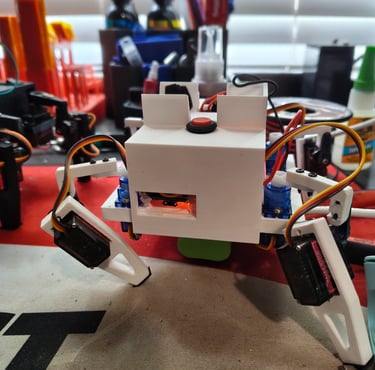
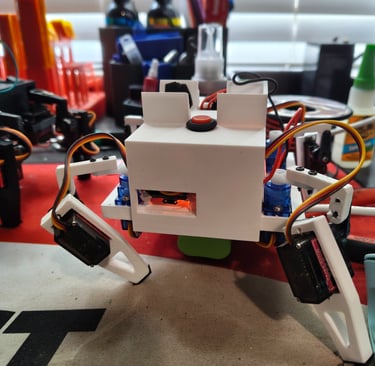
Version 1 of the walking robot was built using an Arduino Nano and a basic servo driver board as a rapid prototyping platform. The system used a simple four leg layout driven by standard hobby servos to test basic gait motion and control logic, and included a physical toggle switch to enable and disable the servos for safer testing and easier debugging. However, the design was large and bulky due to oversized 3D printed body and an inefficient mechanical layout, and the servos frequently stripped under load because of poor torque distribution and structural stress. While mechanically unstable and not suitable for long term use, this version was important for validating basic walking patterns, testing servo synchronization, and identifying mechanical limitations before moving to a more compact and optimized design.

Version 2
Version 2 of the walking robot was redesigned around an ESP32-CAM and a servo driver board in a much slimmer and more compact frame. The updated system improved functionality by adding wireless control and live video feedback while still using a four leg servo based walking layout. However, the aggressive reduction in size made the frame too weak, causing it to snap under load, and the internal wiring layout was poorly managed, leading to reliability issues. Despite these problems, this version was important for exploring compact design constraints, integrating wireless features, and identifying structural and wiring improvements needed for a more robust final build.

Version 3
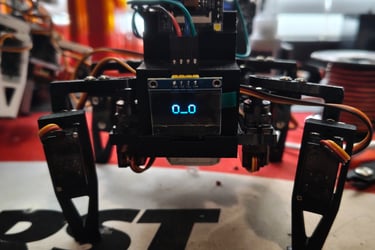
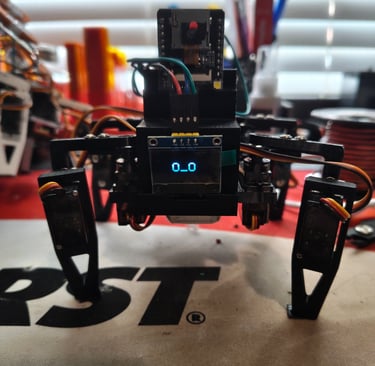
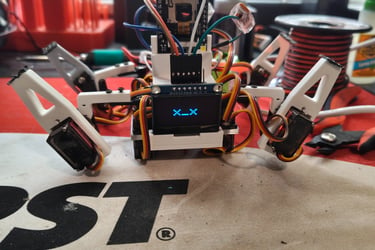
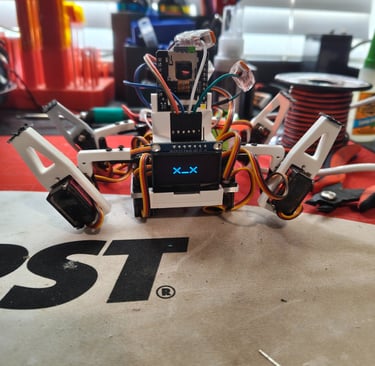
Version 3 of the walking robot kept the same electronics, including the ESP32-CAM and servo driver board, but upgraded the mechanical design with a much thicker and reinforced 3D printed frame. This addressed the structural issues from the previous version, preventing the frame from snapping under load. The four leg servo based walking system was retained, but improved rigidity allowed for more consistent motion and better load handling. The wiring layout was also cleaned up to improve reliability and reduce connection issues. This version focused on structural durability, smoother operation, and creating a more stable platform for continued development and testing.